From Keel Laid to Last Rivet: A Long-Weekend Drive Through Pennsylvania's Shipbuilding Past
Pennsylvania doesn't have an ocean coastline, but it has always had a navy. For more than two centuries, the ships that projected American power were laid down on the Delaware River in Philadelphia and, during one desperate stretch of World War II, on the Lake Erie shore at Erie itself. Most road-trippers think of the state in terms of battlefields and coal patches — and fair enough — but there's a second story written in salt water and spray paint, and it makes one heck of a long-weekend drive.
The route is simple: start in South Philadelphia, point your car north through the Susquehanna country, and end up on Presque Isle's doorstep roughly six hours later. Along the way, you'll pass through working-class neighborhoods that were built by the yards, museums that refuse to let the story drown, and waterfronts where the cranes are gone but the memory isn't.
Day One: The Navy Yard, Where the Story Refuses to Die
Start at the place most people get wrong. Yes, the Philadelphia Navy Yard still exists — it's just not a navy yard anymore. The Navy departed in the 1990s, and the 1,200-acre complex at the confluence of the Delaware and Schuylkill rivers has been reborn as an industrial campus of biotech labs, robotics startups, and offices. It sounds like the story ended. It hasn't.
Drive past the gates (the campus is open to the public) and the ghosts are everywhere. The 1870s-era Officers' Quarters row on Intrepid Avenue is one of the finest collections of Victorian military architecture anywhere in America, and most visitors to the city have no idea it exists. Nearby sits the Marine Parade Ground, and around the corner, the mothballed hulks — including a decommissioned cruiser — still ride at the pier, waiting on a museum future that keeps getting pushed back.
The must-see, though, is the Naval Shipyard's dry docks and the small but excellent exhibits scattered through the historic district. Between 1801 and 1995, this yard built everything from wooden frigates to the battleship New Jersey-class giants of the 1940s, when more than 40,000 Philadelphians swarmed the gates each shift. Give yourself two hours, then grab lunch at the Fishtown or Queen Village neighborhoods on your way out of town — old rowhouse districts that housed the yard workers themselves.
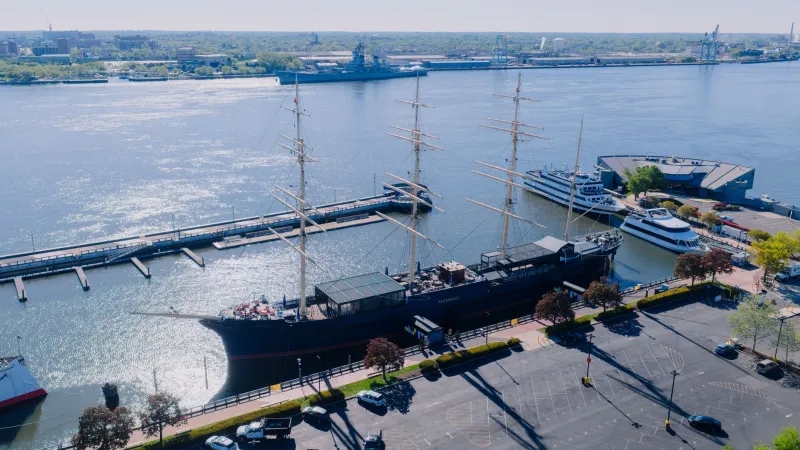
Spend the rest of the day on the Delaware waterfront. Penn's Landing hosts the Moshulu, a four-masted steel-hulled sailing ship (now a restaurant) that represents the tall-ship era the yards grew out of, and the Independence Seaport Museum anchors the story with a real Spanish-American War cruiser, the Olympia — Admiral Dewey's flagship at Manila Bay — plus a WWII-era submarine, the Becuna, that you can climb through.
Day Two: The Long Haul North, With Stops That Earn Their Keep
Day two is driving day — about five hours to Erie — but Pennsylvania's geography makes the miles count. If you're a completist, detour east to the Bucks County and Marcus Hook stretches of the Delaware, where smaller yards and marine railways once serviced the big builders. Or break up the trip with a stop in Harrisburg or Williamsport, where river commerce fed the coastal trade for generations.
If you'd rather bank time for the lake, push straight through on I-81 and US 15, arriving in Erie by late afternoon with enough daylight to walk the Presque Isle shoreline. There's something fitting about ending the day where the state's shipbuilding story nearly ended — on a freshwater sea most people forget is there.
Day Three: Presque Isle's Wartime Miracle
Here's the part of the story almost nobody tells. During World War II, with coastal shipyards under threat from German U-boats, the federal government built a massive new shipyard on the Lake Erie shore at Erie — the Presque Isle Shipyard. Between 1942 and 1945, workers there turned out subchasers and other vessels on a lake that froze solid for months at a time, in a yard that had literally not existed before the war.
The yard itself is long gone — the site now hosts marinas and parkland — but Erie doesn't let the story sink. The Erie Maritime Museum downtown tells the full sweep of the region's naval history, from Oliver Hazard Perry's flagship Niagara (rebuilt and moored nearby, and yes, you can board her) through the WWII boom years. The museum does a genuinely good job connecting Perry's 1813 victory at the Battle of Lake Erie — fought practically offshore — to the industrial mobilization 130 years later.
Walk the Dobbins Landing waterfront afterward, grab a fish sandwich at one of the lakefront spots, and if you have the time, drive the Presque Isle State Park loop at sunset. The water that launched Perry's fleet and later built warships is doing neither now, and there's something quietly moving about that.
Why This Drive Works
What makes this route special isn't any single museum — it's the arc. You start at a yard that became something new, and you end at a yard that vanished entirely, with the Niagara and the Olympia standing in for everything in between. It's a story about American industrial rise and reinvention, told through two waterfronts most travelers blow past on the highway.
Pack a jacket (Erie is its own weather system), book the Navy Yard campus visit ahead if you want to go deep on the historic district, and give yourself three days. The ships are gone. The story, thankfully, is still afloat.