Sects, Stones, and Settlers: Three Days Chasing Pennsylvania's Forgotten Colonies
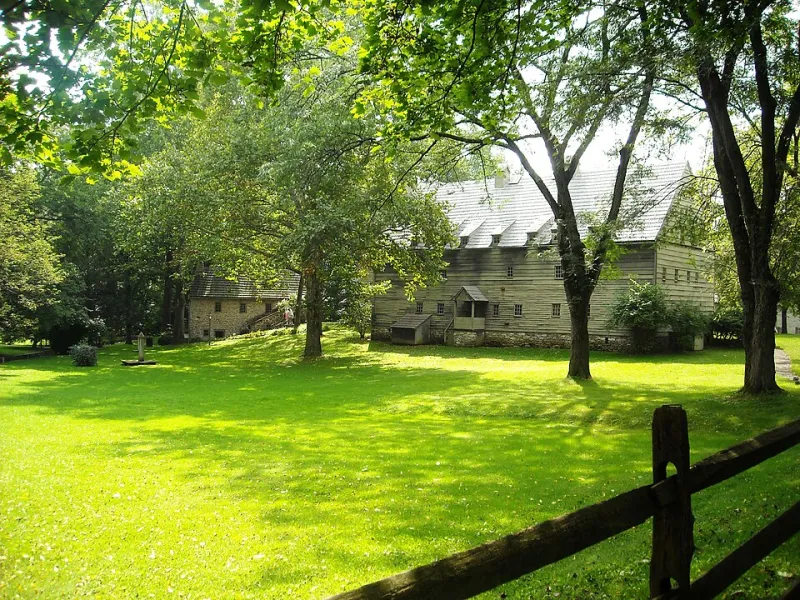
Photo: Elisa Rolle, CC BY-SA 3.0, via Wikimedia Commons
Ask anyone about Pennsylvania's heritage tourism and you'll get the same answer: Amish country. Buggies, pretzels, quilt shops. And look, Lancaster earns its reputation. But the Commonwealth's settlement story is far stranger and more interesting than one well-marketed plain sect. Before the Amish arrived, this land was claimed by Swedes, dotted with Welsh-speaking Quakers, and home to a monastic community that slept on wooden boards and sang seven hymns a day.
Here's a three-day loop that skips the crowds and walks you through the colonies history forgot to market.
Day One: The Swedes Along the Delaware
Start where Pennsylvania's European story really began — not with William Penn, but with New Sweden, established along the Delaware River in 1638, nearly half a century before Penn's arrival.
Your first stop is the Old Swedes Church (Gloria Dei) in Philadelphia's Queen Village, the oldest church building in Pennsylvania, consecrated in 1700. It's an active Episcopal parish now, but the gravestones lean like old teeth and the interior feels every bit its 300-plus years. Docents are happy to explain how the Swedish congregation held services in Swedish well into the 19th century.
Cross the river to Morrisville and Pennsbury Manor, Penn's reconstructed country estate, but don't linger too long — the real prize is downstream. Head to Governor Printz Park in Essington, site of Printzhof, the capital of New Sweden. It's a modest spot, but standing on the riverbank you get the picture: this was a Swedish colony, governed by a man so heavy his men reportedly called him "Big Belly."
Where to eat: The Swedish angle fades fast in the restaurant world, so pivot to Philadelphia's Italian Market or grab a cheesesteak in Queen Village. History doesn't have to dictate lunch.
Where to sleep: Overnight in Center City or West Chester to position yourself for day two.
Day Two: The Welsh on the Main Line
Drive west on Route 30 and you're traveling through what was once the Welsh Tract — a 40,000-acre barony granted to Welsh Quakers in the 1680s. They named their townships after home: Merion, Haverford, Radnor, Bryn Mawr. The Welsh language eventually faded, but the place names stuck, and today's ritzy "Main Line" is a direct linguistic descendant of those sheep-farming settlers.
Stop at the Old Haverford Friends Meeting House in Ardmore, built in 1688 and still holding Quaker meetings. The burial ground holds generations of the original Welsh families — the Humphreys, the Lloyds, the Lewises. Then swing by Harriton House in Bryn Mawr, the 1704 home of Welsh settler Rowland Ellis, later the estate of Charles Thomson, secretary of the Continental Congress for its entire fifteen-year run. One house, two stories, neither told often enough.
Finish at the Lower Merion Historical Society's headquarters in the old Academy in Ardmore, where volunteers can point you to surviving Welsh farmhouses hiding behind modern facades.
Where to eat: Bryn Mawr and Ardmore have plenty of good options — grab dinner at a neighborhood spot along Lancaster Avenue and raise a glass to the Cymry.
Where to sleep: The Main Line's inns are pricey; budget travelers should push west toward Downingtown or Exton.
Day Three: The Mystics of Ephrata
Now for the strangest stop of the trip. Head to Ephrata in Lancaster County — yes, Lancaster County, but a different Lancaster than the tourist brochures.
The Ephrata Cloister, founded in 1732 by the charismatic and perpetually feuding Conrad Beissel, was a monastic commune of German Seventh-Day Baptists. Celibate members slept on narrow wooden benches with wooden blocks for pillows. They composed some of the earliest original sacred music in America — choral works with as many as forty parts. They ran a printing press that produced some of the colonies' most beautiful fraktur and printed the first American edition of the Martyrs' Mirror, a massive tome that took three years to complete.
Take the guided tour (it's worth it — the buildings are original, and the guides know the gossip, including the community's complicated relationship with the Revolutionary War, when it sheltered and buried soldiers after the Battle of Brandywine). Stay for a music program if your timing is right; the Cloister hosts seasonal choral performances that recreate Beissel's compositions in the very rooms where they were first sung. It's haunting, genuinely.
Where to eat: Ephrata and nearby Lititz have excellent Pennsylvania Dutch kitchens — this is the part of Lancaster County where you can get a proper shoofly pie without fighting a tour bus.
Where to sleep: The General Sutter Inn in Lititz offers comfortable rooms in a historic building, plus a solid tavern downstairs.
Why These Places Matter
Pennsylvania's founding promise — religious tolerance, open to all comers — attracted a parade of experimenters: Swedes before Penn, Welsh Quakers seeking a New Wales, German mystics seeking a New Jerusalem. None of them became America's dominant story, but each left fingerprints you can still find: a stone meetinghouse, a street name, a hymn still sung.
The Amish will still be there when you get back. But you'll come home with a story nobody else on the tour bus has.