Company Houses, Company Rules: A Slow Drive Through Pennsylvania's Living Patch Towns
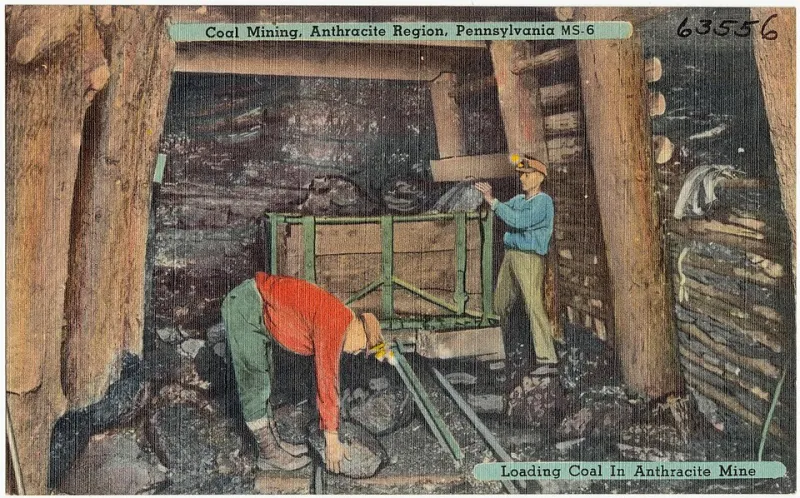
Photo: The Mebane Greeting Card Co., Wilkes-Barre, PA., Public domain, via Wikimedia Commons
Here's the thing nobody tells you about Pennsylvania's coal country: the patch towns never left. Drive Route 940 or the back roads between Hazleton and Shenandoah and you'll pass them constantly without realizing it — long, uniform rows of narrow houses, all the same age, all facing the same direction, many still wearing the company's original paint scheme. These are the villages built by coal operators in the 1800s to house their immigrant workforce, and unlike most ghost towns out West, people never stopped living in them.
That's what makes this a different kind of historic drive. You're not visiting ruins. You're driving past someone's kitchen window.
Start Where They Kept the Whole Town: Eckley
Begin in Carbon County at Eckley Miners' Village, about ten miles east of Hazleton. Eckley is the rare patch town preserved intact — the Pennsylvania Historical and Museum Commission has run it as an open-air museum since the 1970s, and Hollywood noticed too; parts of The Molly Maguires were filmed here in 1969.
The museum's exhibit building does the heavy lifting on context: how operators built entire settlements — church, store, doctor's office, school — and deducted rent from every paycheck. A company town wasn't charity. It was a leash. Workers paid the company for housing, shopped at the company store, and could find themselves evicted with a day's notice if they made trouble for the boss.
Walk the village's main street afterward. The contrast between the ornate doctor's house and the bare wooden dwellings of the laborers is the whole story told in architecture.
Skyline View: A Patch Town That Never Became a Museum
Now head north into Luzerne County toward Skyline View, perched on a ridge above Hazleton. This one's the opposite of Eckley — no ticket booth, no interpreters, just a working neighborhood that happens to be company-built from the ground up. The houses are occupied, maintained, and lived in by families whose grandparents may have worked the same collieries.
This is the part of the trip that requires some self-awareness. Skyline View isn't an attraction. It's a lesson you absorb from the windshield: the same floor plans, the same sight lines toward the old breaker sites, but with satellite dishes and basketball hoops. Pull over only where it's legal, keep your voice down, and don't photograph people's homes.
The Unnamed Rows: Schuylkill County's Open-Air Archive
Cross into Schuylkill County and the patch towns multiply. Around Shenandoah, Mahanoy City, and Frackville, you'll find dozens of named and unnamed patches — Williamstown, Lost Creek, the rows strung along the old Philadelphia & Reading branch lines. Many of these company houses survive because they were cheap, sturdy, and sold off to workers when the collieries closed. The miners' descendants still own them.
A few worth a slow cruise:
- Mahanoy City — one of the densest surviving grids of company housing anywhere in the anthracite field.
- Girardville and Lost Creek — quiet streets where the colliery names on the old maps now mark nothing but culm banks.
- Shenandoah — once so rough it was called the toughest town in America, now a place to get a genuine Coal Region cheesesteak and read the immigrant church spires, one nationality per parish.
How to Do This Trip Right
Time it for a weekday morning. Eckley's museum has limited hours off-season, and the back roads are calmer early. Use the coal region heritage maps published by the Anthracite Heritage Alliance to identify which rows you're passing — it changes the drive completely when you know the town you're looking at was built by the Philadelphia & Reading Coal & Iron Company in 1860.
Eat where the miners ate. A pig-in-a-blanket (the Coal Region kind — a meat-filled cabbage roll, not the appetizer) or a half-moon pie in a Mahanoy City diner is as authentic as this trip gets.
And remember the golden rule of the patch towns: photograph the buildings, wave at the residents, and treat every street like what it is — not a movie set, but the oldest continuously working-class neighborhood in America.